
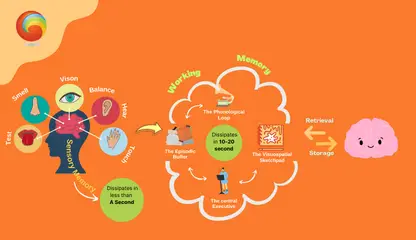
Understanding neurons and your brain can help you learn better. Learn about the four types of learners and the 4 pillars of neurons and learning.
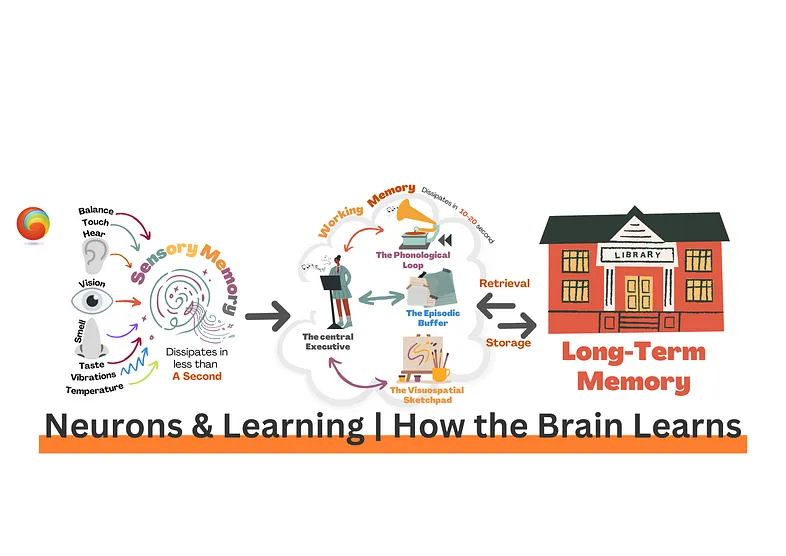
Neurons and Learning: Knowing the simplest techniques for learning can assist you in maximizing your efforts while you are attempting to collect new thoughts, standards, and abilities.
But it’s also the mechanism behind literally every biological development that includes cell memory. Particularly brain cell memory, when mixed with motivation and planned cognitive processing.
So, what are Neurons and Learning?
Learning means retaining the knowledge that you have gained. The learning process begins when you have a new experience, whether that is reading a new word, listening to someone explain a concept, or trying a new method for solving a problem.
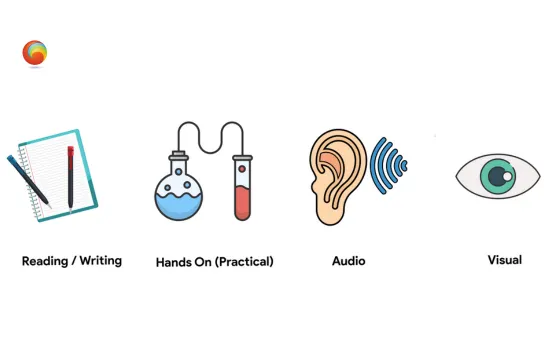
There are basically four types of learners: Reading/Writing, Hands-on, Audio, and Visual. Some people are a combination of these four styles; they have a predominant learning style.
Let’s try to understand the very first step, a Neuron.
Neurons consist of a compact cell body, dendrites, and axons. They are responsible for information processing and converting chemical and electrical signals back and forth.
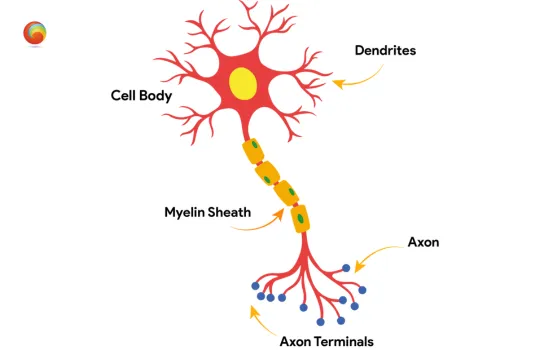
- Dendritesare branch-like extensions that grow outward from the cell body when the environment is enriched.
- Axonshave two essential functions: to conduct information in the form of electrical stimulation and to transport chemical substances.
- Myelinis a fatty substance that forms around well-used axons, and all of the larger axons are myelinated.
So, How do Neurons make Connections?
Axon-Synapse-Dendrite Pathways Are Electrical to Chemical to Electrical.
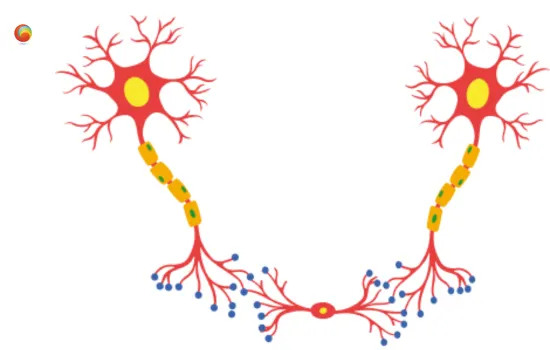
More connections make for more efficient communications. No neuron is an endpoint or termination for information; it only serves to pass it on. A single neuron can receive signals from thousands of other cells, sometimes as far as a meter away, and its axon can branch repeatedly, sending signals to thousands more
Neurons and Learning: Where does Learning take place?
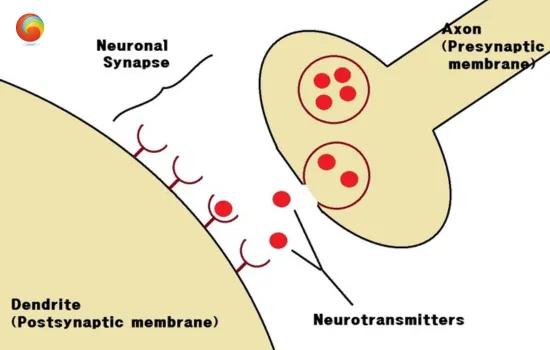
When the cell body sends an electrical discharge outward to the axon, it stimulates the release of those stored chemicals into the synaptic gap, which is the space between the end of an axon and the tip of a dendrite.
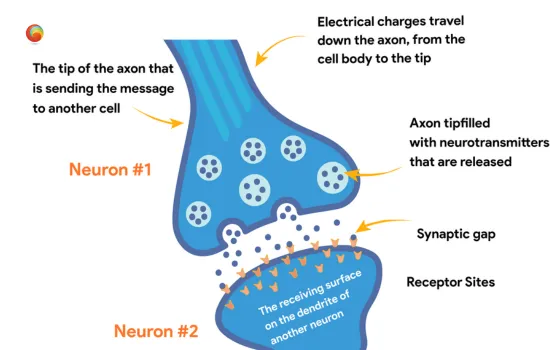
When we say cells “connect” with other cells, we really mean that they are in such close proximity that the synapse is easily, and almost effortlessly, “used” over and over again. New synapses usually appear after learning.
Learning based on Neuron behavior
- Classical conditioning
In classical conditioning, a response already associated with one stimulus is associated with a second stimulus with which it had no previous connection.
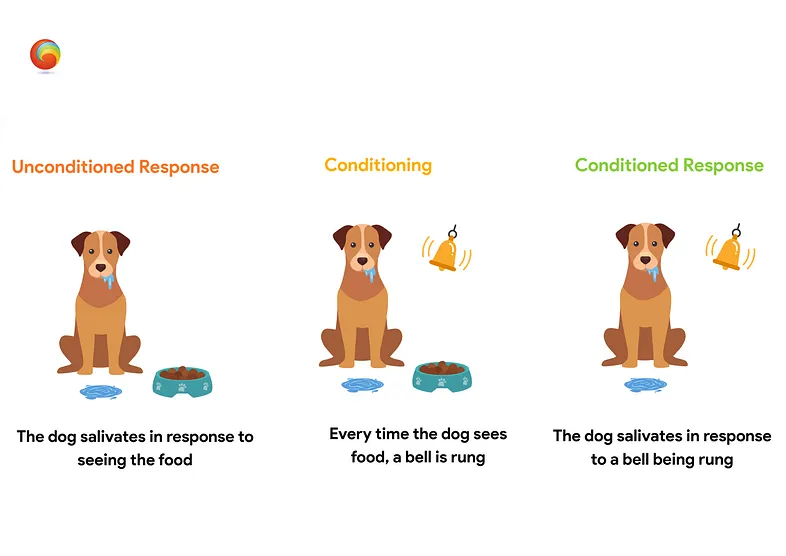 Pavlov’s Experiment of conditioning
Pavlov ( Russian psychologist ) saw that, the dogs would salivate in response to the food placed in front of them, but he noticed that his dogs would begin to salivate whenever they heard the bell indicating that their food is ready.
- Habituation
 Birds don’t fear the scarecrow anymore ( Habituation )
Habituation occurs when we learn not to respond to a stimulus that is presented repeatedly without change, punishment, or reward. We learn not to focus our attention on it. It is a form of non-associative learning that does not require conscious motivation or awareness.
- Sensitization
Sensitization is the strengthening of a neurological response to a stimulus due to the response to a secondary stimulus. Sensitization occurs when a reaction to a stimulus causes an increased reaction to a second stimulus. It is essentially an exaggerated startle response and is often seen in trauma survivors.
 Neurons and Learning: Sensitization
During habituation, fewer neurotransmitters are released at the synapse. In sensitization, however, there are more pre-synaptic neurotransmitters, and the neuron itself is more excitable.
-
Potentiation is a phenomenon in neuronal learning where prior exposure to a stimulus enhances the response to similar stimuli. It contributes to the formation of associations and the strengthening of neural connections, ultimately improving learning and memory capabilities.
-
An example of potentiation can be seen in Pavlov’s classical conditioning experiment. Initially, the sound of a bell (neutral stimulus) did not elicit any response from the dogs. However, after repeatedly pairing the sound of the bell with the presentation of food (significant stimulus), the dogs started salivating in response to the bell alone. The bell, through potentiation, acquired the ability to trigger a response similar to the food.
The 4 Pillars of Neurons & Learning
- Attention
 Neurons and Learning: Attention
Attention plays such an important role in the selection of relevant information that it is present in many different circuits in the brain. Attention is essential, but it may result in a problem: if attention is misdirected, learning can get stuck.
- Active Engagement
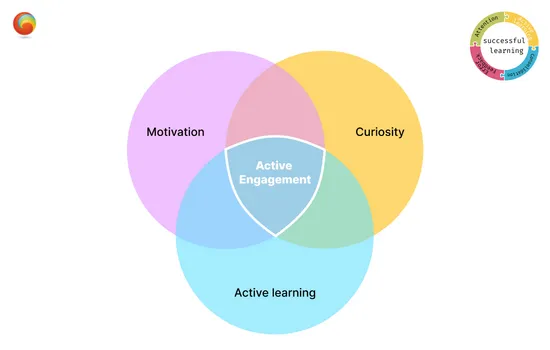 Neurons & Learning: Union of factors leading to active engagement
Active engagement is a way to encourage more student involvement, and we called on faculty to make greater use of active modes of teaching and require that students take greater responsibility for their learning. It involves direct engagement with active learning, motivation, and curiosity.
- Error Feedback
 Neurons and Learning: Sensitization
According to learning theory, a grade is just a reward (or punishment) signal . The grade of an exam is usually just a simple sum — and as such, it summarizes different sources of errors without distinguishing them It is insufficiently informative: by itself, it says nothing about the reason why we made a mistake, or how to correct ourselves. In the most extreme case, an F that stays an F provides zero information, only the clear social stigma of incompetence.
The key role of errors in learning. Making mistakes is the most natural way to learn. The two terms are virtually synonymous because every error offers an opportunity to learn.
- Consolidation
 Neurons and learning: Consolidation
Consolidation is the process ofmaking some concepts stronger. It is essential because it makes our precious brain resources available for other purposes. We cannot reach the highest levels of the educational pyramid without first consolidating its foundations
How Does Stress Affect Neurons And Learning?
A stressful physical environment is linked to student failure. Crowded conditions and poor student relationships even matter.

Students are less able to understand connections or detect more significant levels of the organization. Learning narrows to the memorization of isolated facts. Learners with lower stress levels can put together relationships, understand broad underlying theories, and integrate a wider range of material.